
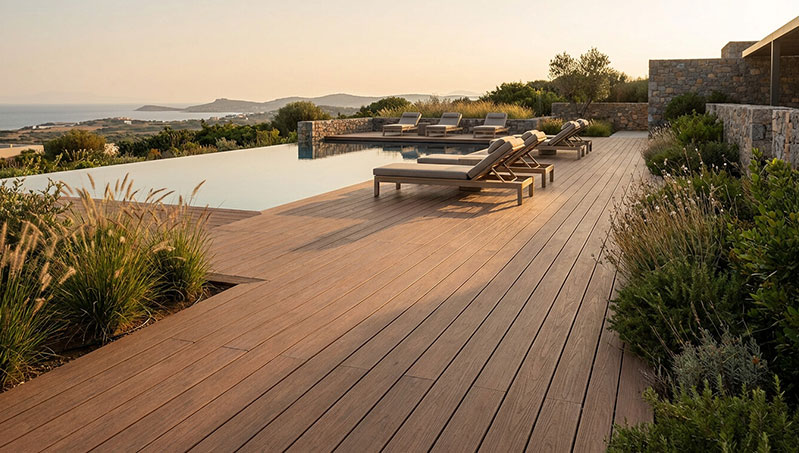
Capped vs Uncapped Composite Decking: What’s the Difference?
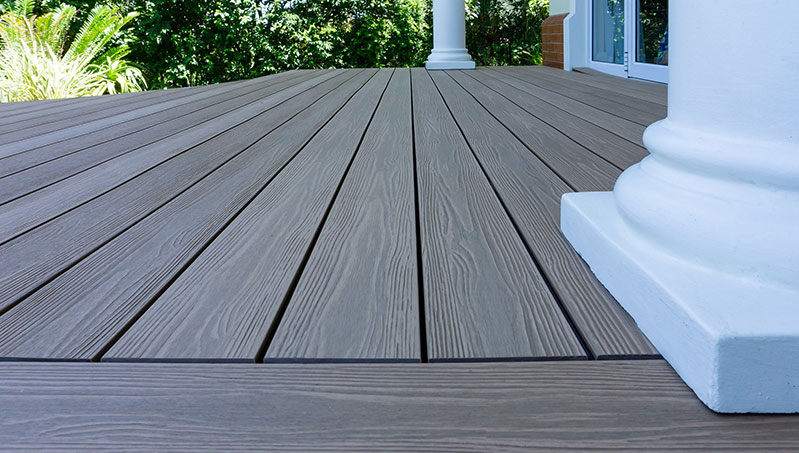
Capped composite decking adds a protective polymer or acrylic surface layer over the composite core, enhancing resistance to stains, fading, scratches, moisture and wear. Uncapped decking leaves the composite material exposed, while still providing the durability and low-maintenance advantages associated with composite decking.
With Eva-Last capped and uncapped decking, the distinction lies in the level of surface protection and price point. Capped technologies provide enhanced protection from everyday exposure, while uncapped boards offer a cost-effective entry into composite decking without the additional protective surface layer.
But capping is only one part of the performance equation.
A decking board has to perform both on the surface, but also structurally. While the cap is primarily responsible for protecting against UV, moisture, stains, abrasion and foot traffic, the composite formulation and board profile beneath it influence other performance characteristics, including strength, stiffness, weight, span capability and dimensional stability.
This is why “capped versus uncapped” shouldn’t be the only factor to be considered. A capped hollow-core board is likely to fail long before an uncapped I-Series board, simply because of the profile design and the moisture retention in the cavities of the hollow-core profile.
Eva-Last’s portfolio offers the best combination of value and longevity. Eva-tech I-Series provides an uncapped bamboo composite option for cost-conscious applications, while Infinity adds highly durable and resilient polymer capping. Apex combines acrylic capping with a lightweight bamboo foamed-PVC core, Apex PLUS offers the same acrylic cap but with a glass fiber reinforced bamboo foamed-PVC core for increased span capability and reduced expansion and contraction. Pioneer pairs advanced digital print replication technology with ceramic wear coating on a glass-fibre reinforcement bamboo foamed-PVC core.
These technologies and compositions allow the board to precisely match the performance requirements, environment, aesthetic expectations and budget of the project.
The question isn’t simply capped or uncapped. It’s what performance is required from the product for the project?
Read More About Composite